
As we wrap up April, we’ve pulled together the most important and interesting updates you should be paying attention to. One of the clearest signals this month came from Amazon’s latest shareholder letter, published by Andy Jassy in April 2026.
For the first time, there is no direct section dedicated to third-party sellers.
The focus is on AI, infrastructure, and automation.
This reflects a broader direction: less reliance on people, more reliance on systems.
For sellers, this changes the game. Success is no longer about reacting, but about precision. Clean data, accurate inventory, and strict compliance are now the baseline.
When the system makes the decisions, the margin for error becomes significantly smaller.

 General Amazon Updates
1. Amazon Doubles Down on Trust & Enforcement
In April 2026, Amazon published its Trustworthy Shopping Experience Report, highlighting the scale of its enforcement efforts. The company proactively blocked hundreds of millions of suspected fake reviews and continues to remove millions of counterfeit products, driven largely by AI and automated systems.
This reflects a shift toward more proactive enforcement, where issues are identified and stopped before they reach customers. For sellers, this is a shift in timing. Issues are being flagged earlier and handled automatically, leaving less room to react.
Monitoring, compliance, and listing quality need to be managed upfront, not after problems appear.
Full article: Trustworthy Shopping Experience Report (Amazon)
2. The Amazon Dependency Model Isn’t Changing
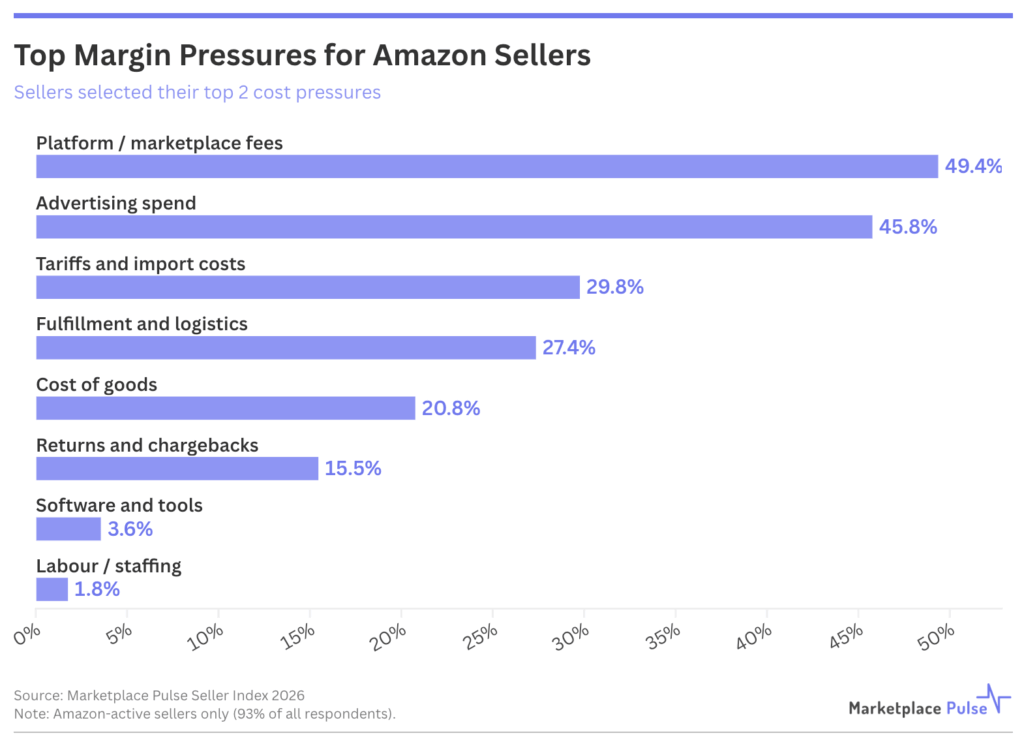
A recent analysis by Marketplace Pulse highlights a core reality of selling on Amazon. Amazon depends on third-party sellers for selection and growth, while sellers depend on Amazon for demand, traffic, and infrastructure. This mutual dependence is not new, but it continues to deepen as sellers scale and rely more on Amazon’s ecosystem.
At the same time, Amazon continues to expand the services those sellers depend on, from fulfillment to advertising, capturing more value as reliance grows.
With few alternatives offering comparable reach, most sellers remain tied to the platform, even as costs increase.
Growth and dependency on Amazon tend to move in the same direction.
Full article: The Paradoxical Dependence (Marketplace Pulse)
 Operations
1. Fuel & Logistics Surcharge (3.5%)
Amazon introduced a temporary 3.5% fuel and logistics surcharge on fulfillment fees for third-party sellers, following a sharp increase in energy and transportation costs linked to the Iran war. The surcharge took effect on April 17, 2026 for FBA sellers in the U.S. and Canada, and expands to Multi-Channel Fulfillment and Buy with Prime starting May 2.
It is applied to fulfillment fees, not product prices.
This reflects a broader shift: Amazon is no longer absorbing volatility at scale, and is increasingly passing operational costs directly to sellers. As a result, margins become more sensitive to external factors, and cost structure needs to be actively managed, not assumed.
Full article: CNBC
2. U.S. Duty Refunds (CAPE Portal)
U.S. Customs and Border Protection has launched the CAPE portal, a centralized system for submitting tariff refund claims where a legal basis exists.
The shift is not in the refunds themselves, but in how they are handled. What was previously a fragmented, case-by-case process is now structured and scalable, allowing importers to review multiple past entries and submit claims in a more organized way.
For sellers importing into the U.S., this turns tariff recovery into a practical lever rather than a one-off opportunity.
Those with structured import data can now identify potential refunds and act on them, turning previously locked costs into recoverable cash that can be reinvested into the business.
3. List & Typical Price Update (End of the “Perpetual Coupon/Sale Price”)
Amazon is tightening how discounts are presented.
As of April 23, 2026, List Price must be based on real recent sales, either on Amazon or through other retailers.
Starting May 18, 2026, Typical Price will reflect the median price over the past 90 days, and will begin to incorporate promotional pricing if deals and coupons are used for a significant portion of that period.
Eligibility for deals and coupons is based on how the product was actually priced in the past 30 days, not just the current list price.
This reduces the ability to maintain artificially high reference prices alongside constant promotions.
Pricing needs to reflect real selling behavior, not perceived discounts. If you’re always on discount, that becomes your new baseline.
Upcoming changes to Reference Pricing
 Advertising Prime Day 2026 – Key Deadlines to Lock In Now
As Prime Day 2026 approaches, key deadlines are already here.
The last day to schedule Best Deals and Lightning Deals with a discounted fee is April 30, with deal submissions closing on May 26. Inventory should arrive by May 27, 2026 to ensure Prime readiness.
We’re already securing deal placements and closely tracking inventory to ensure everything is locked in early.
 AI & Automation How Sellers Are Actually Using AI
A recent analysis by Marketplace Pulse shows that AI adoption among marketplace sellers is already widespread, but usage remains relatively narrow.
Most sellers are using AI primarily for content creation, such as listings and images, rather than for decision-making or strategy.
At the same time, platforms, including Amazon, are rapidly shifting toward AI-driven discovery and recommendations.
This creates a growing gap between how sellers are using AI and how products are actually being surfaced to customers.
At Wise Commerce, we’ve been actively exploring and testing a range of AI-driven tools for some time, focusing not just on content creation, but on understanding how AI reads, ranks, and selects products in this new environment.
Full article: How Marketplace Sellers Are Using AI (Marketplace Pulse)
The Bottom Line
Amazon is becoming more structured, more automated, and less forgiving.
The direction is clear: less room for shortcuts, more need for precision.
As always, we are here to help you navigate these changes and stay ahead of the curve.
Know someone who might find this newsletter useful? Feel free to share it with them.
Regards,
Meirav