
Planning ahead will not prevent surprises, but it helps you stay focused and make better decisions when conditions change.
That sounds obvious, but in the hectic world of e-commerce it is easy to lose momentum once the year gets busy. You start with strong intentions, then reality hits. 2025 was a constant reminder of how quickly the math can shift. Tariffs changed unexpectedly, shipping and freight costs became unpredictable, and Amazon inventory costs, including storage, aged inventory surcharges, and inbound placement fees, made delays and slow-moving stock more expensive.
As we enter 2026, the pace of change is even faster. AI is reshaping how shoppers discover products, how Amazon surfaces listings, and the tools marketers have at their disposal. The sellers who perform well over time are not the ones who try to predict every change. They are the ones who set a clear direction, track the right signals, keep testing what is new, and improve based on results.
At Wise Commerce, we believe goals matter because they create clarity. They help you decide what to prioritize, what to ignore, and what success actually looks like. We use a simple 7-step framework, inspired by Tony Robbins, to turn annual targets into an execution plan that is tracked, reviewed, and adjusted using performance data.
Here is how to apply it to your Amazon business in 2026.
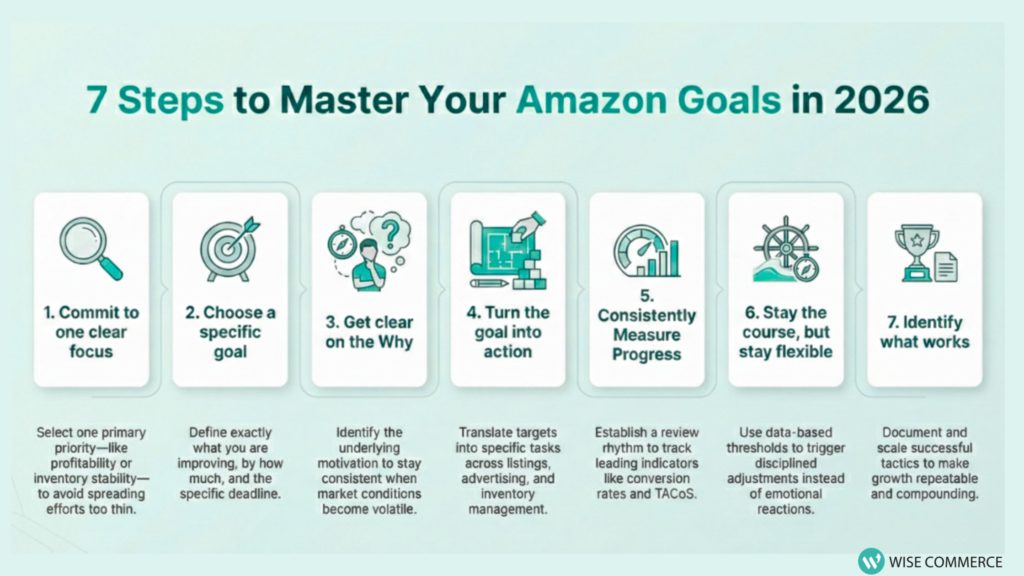
Step 1: Commit to one clear focus
On Amazon, it is easy to spread your effort too thin. Real progress usually comes from choosing one clear priority and sticking with it. Start by picking one primary focus for 2026. This should be the goal that would make the biggest difference to your business if you hit it.
Common priorities:
- Profitability: improve contribution margin, reduce wasted ad spend, tighten discounts
- Healthy growth: scale revenue while keeping TACoS and cash flow under control
- Conversion: raise conversion rate so more traffic turns into sales
- Inventory stability: fewer stockouts, fewer costly storage surprises, better forecasting
- Account strength: reduce compliance risk, protect listing health and performance
Commitment means tradeoffs, and it also means you will measure what is working. When tariffs, freight, and Amazon fees change the cost structure, vague goals are not enough. A clear priority helps you adjust without changing direction every time the market shifts.
Step 2: Choose a specific goal
A goal becomes useful when it is clear enough to guide decisions. “Grow on Amazon” or “improve ads” is not specific enough, especially when costs, competition, and shopper behavior can change quickly.
Define your 2026 goal in a way that answers:
- What exactly are we improving
- By how much
- By when
Examples:
- Increase contribution margin from X% to Y% by Q3 2026
- Reach $X in monthly revenue by November 2026 while keeping TACoS under Y%
- Reduce stockout days by Z% before Prime Day, while maintaining rank on core keywords
Also add a guardrail, because Amazon makes it easy to chase one number and damage another. For example: protect margin, protect rating, or protect cash flow.
This is where being data-driven matters. Start with a baseline: last year’s performance, current fees, current landed costs, current conversion rate, and current ad efficiency. Without a starting point, it is hard to measure progress or understand what caused improvement.
Step 3: Get clear on the Why
The why is what keeps the goal alive when the year gets messy. On Amazon, there will be weeks where costs shift, performance dips, or an unexpected change forces quick decisions. A clear “Why” helps you stay consistent instead of reacting to every fluctuation.
For businesses building their brand on Amazon, the motivation is never purely business. Behind the numbers are real people: employees, partners, suppliers, and family members who rely on their stability. Your goal might be tied to profit, growth, or launching new products, but behind it is usually something bigger: reliable cash flow, lower risk, and a business that can handle change without putting everything under pressure. When the why is clear, it becomes a filter for priorities and tradeoffs all year.
Step 4: Turn the goal into action
This is where you translate your goal into what you will actually do, consistently, across the areas that drive Amazon performance. The focus areas below matter because they are the parts of the Amazon system you can influence directly. They shape how shoppers discover you, whether they convert, whether you stay in stock, and whether growth is profitable.
In 2026, your plan should include strong fundamentals and a deliberate space for testing new tools and AI-driven shifts in shopper behavior.
Listing and conversion
Keep improving how your product is understood in seconds. Clear positioning, strong imagery, and content that answers real objections matter even more as discovery becomes more AI-influenced.
Advertising and PPC
Stay disciplined on structure and efficiency, but make testing part of the plan. Amazon’s ad tools keep evolving, and AI-driven placements and targeting are changing what “good performance” looks like.
Inventory planning
Treat inventory as a strategic priority, not just an operations task. 2025 showed how quickly tariffs and shipping costs can change landed costs, and Amazon’s inventory fees can make delays and slow-moving stock more expensive.
Pricing and promotions
Plan promotions early and use them with intent. The goal is not to discount more, it is to use pricing and deals in a way that supports margin, ranking, and long-term performance.
Innovation and new technologies
Make innovation a defined focus area, not something you “get to later.” Set a testing rhythm for new capabilities, including AI-related changes to discovery, content, and advertising. Keep it structured: test, measure, decide, then move on.
The point is not to do everything at once. It is to choose the few actions in each focus area that support your 2026 goal, then execute and test consistently.
Step 5: Consistently Measure Progress
Goals often fail when progress is not tracked consistently. On Amazon, measurement should be simple and actionable, a small set of leading indicators that tell you early if you are moving in the right direction.
Track signals like conversion rate, sessions, CTR, CPC, and in-stock rate, along with the main outcome metric tied to your 2026 goal.
Then commit to a review rhythm:
Yearly analysis: review what actually drove results, and use it to set the next cycle
Yearly planning: set the goal, align budgets, and map key seasonal moments
Weekly check: are we moving in the right direction
Monthly review: what changed, what worked, what needs a decision
Quarterly reset: adjust the plan based on what the data is telling you
Step 6: Stay the course, but stay flexible
Even the best plan will get tested. 2025 gave sellers plenty of examples and we’re sure the next
years will be even less predictable. When the cost structure moves, the same actions can produce very different results. “Sticking to the plan” without looking at the numbers can be just as risky as overreacting.
This is why flexibility should be designed into your 2026 plan, and it should be data-based, not emotional or reactive.
Data-based flexibility means:
- You decide in advance which metrics signal a real change, not just noise
- You set thresholds that trigger a review, and you act when they are hit
- You adjust with discipline, one decision at a time, and measure the impact
Practical examples:
- If landed costs rise (tariffs, freight, supplier pricing), revisit pricing, promo depth, and ad efficiency, with margin as the guardrail
- If in-stock rate starts slipping, shift attention to replenishment and forecasting before spending more on traffic
- If CPC rises but conversion does not improve, tighten targeting or improve the listing before increasing budgets
- If inventory fees start climbing, reassess stocking levels, shipment timing, and which SKUs deserve deeper inventory
The goal is not to predict every disruption. The goal is to build a plan that absorbs change without losing direction, using data to separate short-term fluctuations from real shifts, and making decisions early enough that you still have options.
Step 7: Identify what works
This step is about making progress repeatable.
When something works, do not just move on. Capture it, understand why it worked, and build it into your operating plan. That might be a messaging update that lifted conversion, a campaign structure change that reduced wasted spend, a forecasting adjustment that prevented stockouts, or a testing approach that helped you adopt new tools faster.
Momentum matters because Amazon performance compounds. Small improvements in conversion, in-stock rate, and ad efficiency add up over time. In a year where AI-driven discovery and automation keep evolving, steady innovation is easier when you are already operating with a consistent rhythm.
Celebrate progress, but keep it practical. Use each win as proof of what to repeat, what to scale, and what to stop doing. This is how a 2026 goal turns from a target into a system that produces results.
Bringing it together: A plan for success in 2026
2026 will be unpredictable. Costs can shift quickly, shopper behavior is changing, and AI is reshaping discovery on Amazon and beyond. That is exactly why goals matter.
A strong Amazon goal for 2026 starts with focus, one clear priority, defined in a way you can measure. It needs a real why behind it, because people and businesses depend on the outcome. From there, translate the goal into action across the focus areas that drive performance: listing and conversion, advertising, inventory, pricing and promotions, and structured innovation.
Most importantly, manage the year with data-based flexibility. Track a small set of leading indicators, review performance on a weekly, monthly, and quarterly rhythm, and adjust based on what the numbers are telling you, not on guesswork.
This is how goals turn into an actionable plan, and how an Amazon business stays stable, innovative, and profitable through change.