
Hi All,
August brought a mix of encouraging market signals and important Amazon changes. U.S. e-commerce continued to accelerate, while Amazon pushed further into AI, seller tools, advertising, and new shopping experiences. For us, the main focus now is Q4 readiness: making sure inventory, pricing, promotions, advertising, content, and operations are all aligned before the busiest part of the year.
Here’s a recap of what mattered most this month:
E-Commerce Is Taking Share From Stores Again
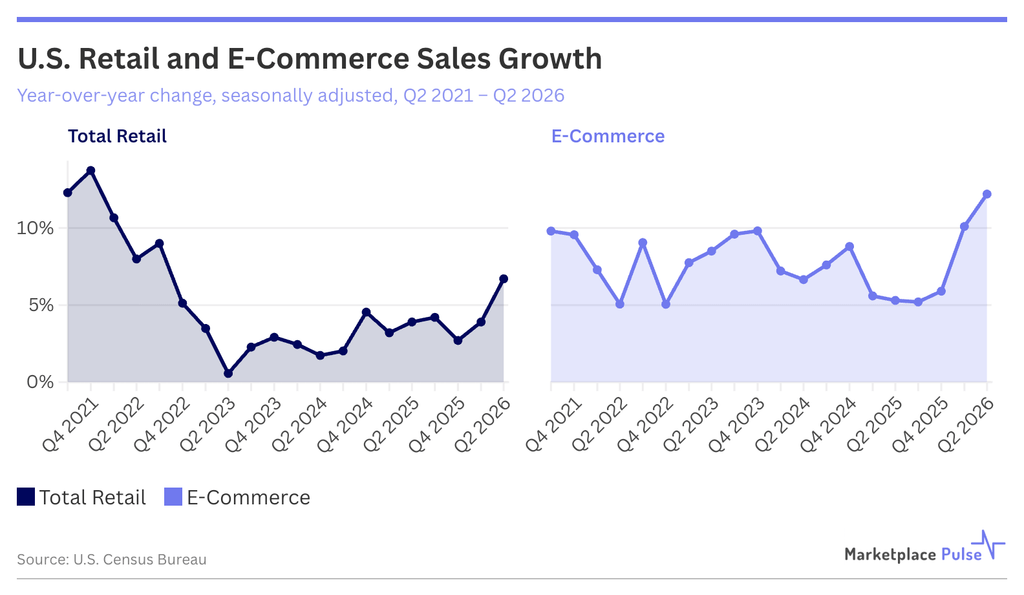
U.S. e-commerce grew 12.2% in Q2, its fastest pace in five years, and reached a record 17.1% of total retail spending.
Even after accounting for higher prices, Marketplace Pulse estimates real growth at roughly 8%, making this the strongest e-commerce market in three years. If that momentum continues into Q4, it is an encouraging sign heading into the holiday season.
Read the Marketplace Pulse analysis →
MARKETPLACE & STRATEGY | How AI is changing product research, discovery and the shopping journey.
Amazon Is Starting to Validate Product Ideas Before Launch
A new Validate a Product Idea feature has started appearing inside Product Opportunity Explorer. Sellers can describe a product concept, including its positioning, features and target price, and Amazon compares that idea with products already competing in the category.
This moves Product Opportunity Explorer beyond identifying niches and toward helping sellers evaluate a specific concept before investing in inventory.
OUR TAKE: We tested it ourselves. It’s useful for spotting gaps in positioning, features and pricing, but it’s not a final go/no-go decision. Amazon has powerful marketplace data, but it does not replace analysis of margins, COGS, manufacturing, compliance, launch budget or brand strategy.
Perplexity Wins an Early Round in Its Fight With Amazon
A U.S. appeals court overturned a preliminary injunction that had restricted Perplexity’s Comet shopping agent from operating on Amazon.The ruling is narrow. It does not establish a general right for AI agents to access Amazon or other marketplaces, and the underlying legal dispute continues.
OUR TAKE: It is still too early to know where this case will land, but it is an important one to watch.
The outcome could help define how far Amazon can go in restricting third-party AI shopping tools and shape how external AI agents interact with marketplaces in the future.
From a 1910 Sears Catalog to Conversational Shopping
Doug Herrington, Amazon’s CEO of Worldwide Stores, keeps a Sears and Roebuck catalog from around 1910 in his office. Amazon uses the example to illustrate how shopping formats evolve.
Amazon’s view is that conversational AI is the next major format shift in retail. Alexa for Shopping lets customers ask questions in natural language and receive personalized answers instead of simply scrolling through lists of products.
ADVERTISING | Amazon is pushing Sponsored Products beyond the traditional marketplace experience.
Sponsored Products Are Expanding Through Creators
Starting in August, Sponsored Products became eligible to appear through creators in the Amazon Influencer Program.
The rollout uses existing Sponsored Products campaigns, including their current bids and budgets, so advertisers do not need to build a separate campaign structure.
OUR TAKE: The immediate performance impact may be limited, but the move is another sign that Amazon continues to experiment with creators as a distribution layer for commerce and advertising.AI & SELLER TOOLS
Amazon continues to put AI directly into day-to-day seller workflows.
Amazon Now Requires Tags for Photorealistic AI-Generated People
Amazon now requires sellers to tag images and videos containing photorealistic AI-generated people before uploading them to listings and A+ Content across its worldwide stores.
Amazon Is Automatically Translating Text Inside Product Images
Amazon is now automatically translating text embedded in secondary product images into shoppers’ preferred languages across multiple Amazon stores. The main product image is excluded.
The particularly interesting part is that localization can also happen inside the same marketplace, based on the shopper’s language preference.
Read the official Amazon update →
Just Ask Why You’re Not the Featured Offer
Amazon’s Seller Assistant can now tell sellers why their offer isn’t winning the Featured Offer.
“Why am I not the Featured Offer on [your ASIN]?”
Seller Assistant analyzes buyability, pricing, delivery speed and regional coverage, then recommends actions that could improve the offer.
Amazon Adds an AI Canvas to Seller Central
Amazon’s new Canvas combines Seller Assistant with dynamic visual workspaces built from the seller’s own account data.
Try asking:
- Can you analyze my sales performance?
- What products should I restock?
- What if demand drops 10%?
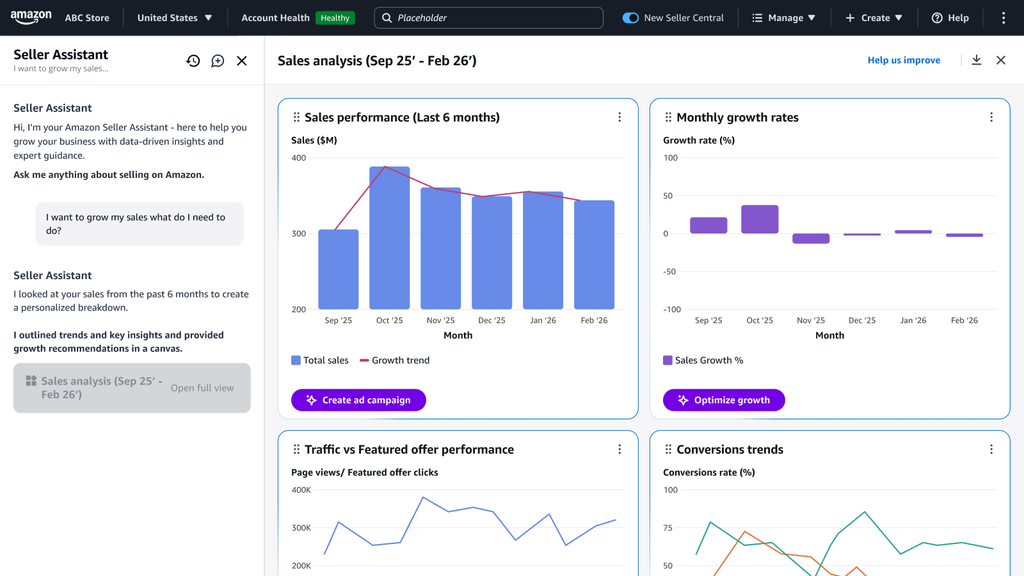
See Amazon’s Canvas examples →
EUROPE | A regulatory update for brands selling in the EU.
New EU Rules Put Green Claims Under Much More Scrutiny
Starting September 27, brands selling in the EU will face stricter rules on environmental claims such as “eco-friendly,” “green,” “climate friendly” and similar sustainability language.
The rules also apply to sustainability labels, badges and symbols used on the product, packaging, or product page, and these need to be backed by a recognized certification scheme or public authority.
WHAT SELLERS SHOULD KNOW
Review product pages, A+ Content, Stores, packaging, and advertising for environmental claims, sustainability labels, badges, and symbols. Make sure any broad claims are properly supported, and remove or revise anything that cannot be clearly proven before September 27.
Read the European Commission guidance →
WORTH WATCHING
Prime Air Is Expanding to Nearly 500 U.S. Cities and Towns
Amazon plans to expand Prime Air drone delivery to nearly 500 U.S. cities and towns by the end of 2026, around six times its current footprint.
Eligible products can be delivered in as fast as 30 minutes. There is no immediate action for sellers here, but it is another reminder of how aggressively Amazon continues to push customer expectations around delivery speed.

Amazon News
There is a common thread running through many of August’s updates: both sides of the Amazon marketplace are becoming more automated.
In Summary
Customers are increasingly interacting with conversational shopping tools and potentially AI agents, while sellers are getting AI tools to research opportunities, diagnose problems and interpret their own business data.
The opportunity is not simply to use more AI. It is to make sure the data, content and decisions feeding those systems are accurate, structured and differentiated.
Looking forward to September and what it will bring.
Regards,
Meirav